
Call us now :08045478105
 Send Inquiry
 Send Inquiry
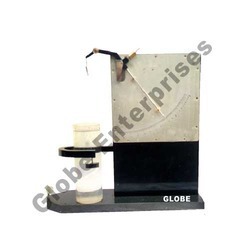
Demattia Flex Tester
Price 85000.0 INR/ Unit
MOQ : 1 Unit
Demattia Flex Tester Specification
- Application
- Assessment of crack/flex resistance of rubber/vulcanized samples
- Number of Specimens
- Six (6)
- Temperature
- Ambient
- Gas Pressure
- Ambient
- Resolution
- 1 cycle
- Display Type
- Digital Counter
- Frequency
- 50 Hz
- Response Time
- Instant
- Port Size
- Standard
- Interface Type
- Push button/manual
- Accuracy
- 1 cycle
- Operating Voltage
- 230 V AC
- Measuring Range
- Up to 100,000 cycles
- Max Height
- Approx. 350 mm
- Automation Grade
- Manual
- Power Supply
- 230 V AC, 50 Hz
- Features
- Robust construction, easy specimen mounting, digital cycle counter
- Specimen Size
- 70 mm (L) x 45 mm (W) approx.
- Mounting Type
- Floor mounted
- Usage
- Rubber testing laboratory equipment
- Capacity
- Six test stations
- Machine Weight
- Approx. 65 kg
- Test Speed
- 300 cycles per minute
- Test Width
- Various as per specimen size
- Test Stroke
- 25 1 mm
- Control Mode
- Manual
- Accessories Provided
- Set of six clamps, sample cutting template, user manual
- Frame Material
- Mild Steel, powder coated finish
- Grip Type
- Adjustable clamps for test specimens
- Compliance Standards
- IS 3400 (Part 14), ASTM D430
- Safety Features
- Emergency stop button, overload protection
- Finish
- Corrosion resistant paint
- Cycle Counter Type
- Presettable digital counter with automatic stop
Demattia Flex Tester Trade Information
- Minimum Order Quantity
- 1 Unit
- Payment Terms
- Cash on Delivery (COD), Cheque, Cash Advance (CA)
- Supply Ability
- 100 Units Per Month
- Delivery Time
- 1 Week
- Main Export Market(s)
- Asia
- Main Domestic Market
- All India
About Demattia Flex Tester
The ability of rubber products to withstand repeated flexing without developing cracks is of prime importance where such products are used in conditions undergoing repeated flexing.
Flexing endurance of rubber products is determined by simulating in the laboratory the action of flexing repeatedly under standard conditions of speed, mode, and degree of flexing.
One of the accepted procedures for determination of flexing resistance makes use of a De Mattia flexing tester. This tester provides useful information about the resistance of compounds of vulcanized rubber to flex cracking when subjected to flexing. Cracks develop in that part of the surface where stresses are set up during flexing, or if that part of the surface initially contains a crack, cause this crack to extend in a direction perpendicular to the stress.
Technical specification
Current | 3 A |
Driven Type | Electric |
Weight | 55 Kg |
Frequency | 50 Hz |
Phase | Single Phase |
Display Type | Digital |
Automation Grade | Semi-Automatic |
Brand | Globe Enterprises |
Dimension | 430 x 430 x 720 mm |
Material | SS |
Voltage | AC 220 V |
Reliable Assessment of Flex Resistance
Engineered for accurate crack/flex resistance testing, the De-Mattia Flex Tester allows laboratories to analyze the endurance of rubber samples under cyclic stress. Its manual operation and precise digital cycle counting enhance the reliability of results, adhering to international testing standards for consistent quality assurance.
Rugged and User-Friendly Construction
Crafted from powder-coated mild steel, the tester offers excellent corrosion resistance and long-term durability. Adjustable clamps make specimen mounting easy, while accessories such as a cutting template and user manual ensure a smooth setup. Safety features like emergency stop and overload protection support secure operation.
Versatile Application and Easy Control
Accommodating up to six test specimens simultaneously, the tester enables efficient batch assessments. Push-button interface and manual control provide straightforward operation, suited to various laboratory environments assessing rubber and vulcanized material performance.
FAQs of De-Mattia Flex Tester:
Q: How does the De-Mattia Flex Tester measure crack or flex resistance in rubber samples?
A: The De-Mattia Flex Tester measures crack or flex resistance by subjecting up to six mounted rubber specimens to repeated flexing movements. The presettable digital cycle counter records each flex cycle, allowing for precise determination of when cracks begin to appear, up to a maximum of 100,000 cycles.Q: What specimen sizes and types are compatible with this tester?
A: The tester accommodates six specimens of approximately 70 mm in length by 45 mm in width. It is suitable for various rubber or vulcanized samples, complying with IS 3400 (Part 14) and ASTM D430 standards for dimension and test configuration.Q: When should the emergency stop or overload protection features be used?
A: The emergency stop button should be pressed immediately in case of any operational malfunction or safety hazard during testing. The overload protection automatically engages to safeguard the machine and operator if excessive force or an unexpected mechanical load is detected.Q: Where is the De-Mattia Flex Tester typically used?
A: This tester is widely used in rubber testing laboratories across manufacturing, quality control, research and development sectors, particularly in India by exporters, manufacturers, and suppliers needing reliable flex resistance analysis of their materials.Q: What benefits does the digital cycle counter provide over manual counting methods?
A: The digital cycle counter ensures accurate, automatic recording of each flex cycle with 1 cycle accuracy and a 1 cycle resolution. This eliminates errors associated with manual counting, provides real-time response, and supports automatic machine stop when the preset cycle count is reached.Q: How is the De-Mattia Flex Tester operated and specimens mounted?
A: The device is controlled manually through a push-button interface. Adjustable clamps are provided for easy and secure mounting of each specimen, and a sample cutting template is included to ensure conformity in specimen preparation. The user manual outlines step-by-step setup and procedure.Q: What are the main advantages of using a powder-coated mild steel frame for this tester?
A: A powder-coated mild steel frame offers enhanced corrosion resistance, mechanical strength, and long-lasting durability. This construction ensures the device maintains stable performance and extends its operational lifespan in laboratory environments.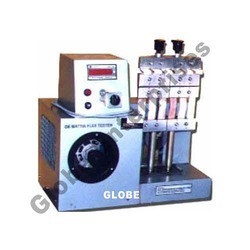
Tell us about your requirement

Price:
Quantity
Select Unit
- 50
- 100
- 200
- 250
- 500
- 1000+
Additional detail
Mobile number
Email

More Products in Rubber Testing Equipments Category
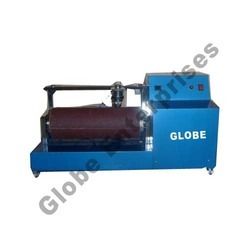
Din Abrasion Tester
Price 60000 INR / Unit
Minimum Order Quantity : 1 Unit
Usage : Quality Control, Laboratory Testing
Machine Weight : 70 kg
Equipment Type : Abrasion Tester
Specimen Size : 6 mm thickness, 16 mm width
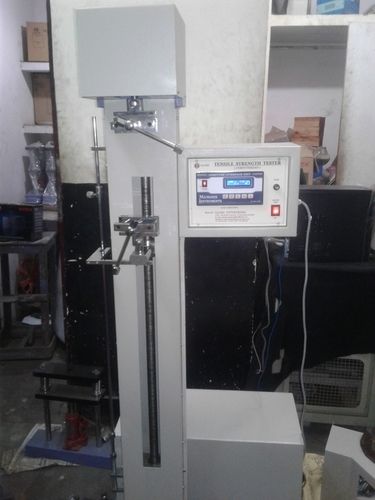
Tensile Strength Tester
Price 125000 INR / Unit
Minimum Order Quantity : 1 Unit
Usage : Material strength testing
Machine Weight : Approx. 50 kg
Equipment Type : Tensile Strength Tester
Specimen Size : As per standards (ASTM/DIN/IS/ISO)
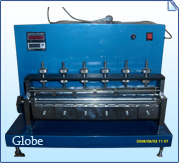
Flex Testing Machine
Price 85000.0 INR / Unit
Minimum Order Quantity : 1 Unit
Usage : Lab and industrial testing of flex resistance
Machine Weight : Approx. 60 kg
Equipment Type : Flex Testing Machine
Specimen Size : 70 mm x 45 mm
Specific Gravity Balance
Price 22500.0 INR / Unit
Minimum Order Quantity : 1 Unit
Usage : For Laboratory Testing of Material Density
Machine Weight : Approx. 7.5 kg
Equipment Type : Specific Gravity Balance
Specimen Size : Solid or Powdered Samples up to 100 mm

We are mainly looking inquiries from Ghaziabad, Bahadurgarh, Kanpur, Agra and Chennai.
 Send Inquiry
Our Products
- Fabric Testing Equipments
- Foam Testing Equipments
- Footwear Testing Equipments
- Leather Testing Equipments
- Plastic Testing Equipments
- Rubber Testing Equipments
- Helmet Testing Equipement
- Yarn Testing Equipement
- Paper & Paperboard Testing Equipments
- Bursting Strength Tester
- Quadrant Scale
- Industrial Flammability Tester

373/7, Mukund Nagar, Industrial Area, Ghaziabad - 201001, Uttar Pradesh, India

Mr. Ishamuddin
(Proprietor)
Mobile :08045478105
 Send Inquiry
 Send SMS
Developed and Managed by Infocom Network Private Limited.
