
Call us now :08045478105
 Send Inquiry
 Send Inquiry
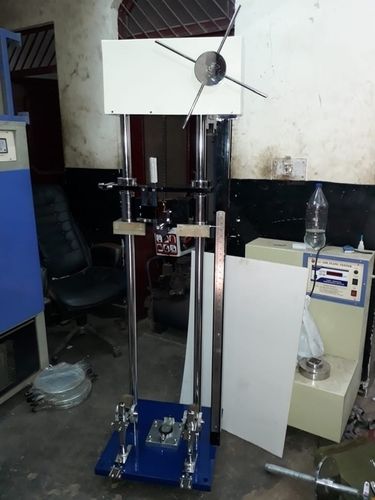
Ross Flex Tester
Price 85000.0 INR/ Piece
MOQ : 1 Piece
Ross Flex Tester Specification
- Accuracy
- 1 cycle
- Power Supply
- 220V AC, 50 Hz
- Port Size
- Standard
- Display Type
- Digital Counter
- Temperature
- Room Temperature (controlled environment recommended)
- Operating Voltage
- 220V AC
- Max Height
- Approx. 450 mm
- Specimen Size
- 70 x 10 x 2 mm
- Number of Specimens
- 6 specimens
- Frequency
- 50 Hz
- Equipment Type
- Ross Flex Tester
- Application
- Testing flex resistance of rubber, footwear, synthetic materials etc.
- Measuring Range
- Up to 99,999 cycles
- Interface Type
- Manual loading, digital count display
- Hardness
- Suitable for soft to moderately hard rubbers
- Features
- Sturdy construction, digital cycle counter, easy specimen loading
- Resolution
- 1 cycle
- Test Range
- 099999 cycles
- Humidity
- Ambient or as per requirement
- Response Time
- Instantaneous
- Usage
- Flex testing of rubber and elastomeric products
- Capacity
- 6 samples per batch
- Machine Weight
- Approx. 60 kg
- Test Speed
- 60 cycles/min
- Test Width
- Standard width (as per ASTM D1052)
- Test Stroke
- 25.4 mm (1 inch)
- Control Mode
- Digital Controller
Ross Flex Tester Trade Information
- Minimum Order Quantity
- 1 Piece
- Payment Terms
- Telegraphic Transfer (T/T), Cheque, Cash Advance (CA)
- Supply Ability
- 100 Pieces Per Month
- Delivery Time
- 15 Week
- Main Export Market(s)
- Asia
- Main Domestic Market
- All India
- Certifications
- ISO 9001-2008
About Ross Flex Tester
Ross Flex Tester
The ability of shoes or chappals to withstand repeated bending experience during walking without developing a crack within their estimated life span is a very important factor for determining the quality of its sole. Also, the ability of the sole to withstand propagation of any slit formed due to a sharp edge or pointed object during walking is equally important in assessing its quality.
Technical specification
Bend Radius | 5 mm |
Voltage | 220 V |
Frequency | 50 Hz |
Brand | Globe Enterprises |
Test Specimen Diameter | 150 x 25 x 6.3 mm |
Slit Width | 2.5 mm |
Flexing Frequency | 100 +- 5 Cycles Per Minutes |
Bending Specimen Angle | 90 Degree |
Precise Flex Testing for Rubber and Elastomers
Utilize the Ross Flex Tester to thoroughly assess the resistance of rubber and synthetic samples under repeated flexing. The advanced digital controller and counter guarantee precise measurement, making it suitable for soft to moderately hard rubbers within quality assurance and research laboratories. Its user-friendly design and reliable performance support efficient material testing.
Built for Performance and Accuracy
Manufactured with sturdy materials, the tester withstands rigorous testing environments. The digital system allows for instant and accurate cycle counts, while its easy specimen loading streamlines the process. The tester operates at 220V AC, 50 Hz, and is engineered for operational safety and long-term reliability, serving industrial applications across India.
FAQs of Ross Flex Tester:
Q: How does the Ross Flex Tester operate during a test cycle?
A: The tester operates by repeatedly flexing six specimens at a consistent stroke of 25.4 mm and a speed of 60 cycles per minute. The digital controller monitors the process, accurately recording the number of cycles up to 99,999, and provides instant feedback via the digital counter.Q: What materials can be tested using the Ross Flex Tester?
A: This equipment is designed for flex resistance testing of various materials, including rubber, footwear components, and synthetic elastomers. It is suitable for soft to moderately hard rubbers as specified by the application requirements.Q: When should flex testing be conducted using this machine?
A: Flex testing should be conducted during product development, quality assurance, or whenever there is a need to evaluate the durability and flex life of rubber or synthetic components used in footwear or related industries.Q: Where is the Ross Flex Tester typically used?
A: The tester is primarily used in manufacturing facilities, quality control laboratories, and research institutes involved in the production and assessment of rubber, footwear, and synthetic materials.Q: What is the process for loading and testing specimens?
A: Specimens, each sized 70 x 10 x 2 mm, are manually placed onto the sample holders. Up to six samples can be tested simultaneously. Once loaded, the digital controller is set and the test started; the digital counter tracks and displays the number of flex cycles completed.Q: What are the key benefits of using the Ross Flex Tester?
A: The main benefits include accurate and reliable flex life assessment, significantly reducing the risk of material failure in end-use products, easy operation with a digital control system, and the capability to test multiple samples simultaneously for efficient batch testing.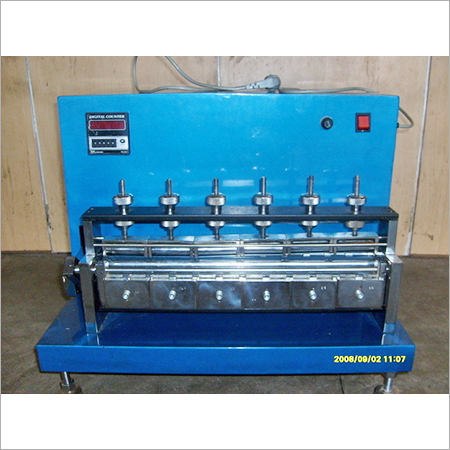
Tell us about your requirement

Price:
Quantity
Select Unit
- 50
- 100
- 200
- 250
- 500
- 1000+
Additional detail
Mobile number
Email

More Products in Footwear Testing Equipments Category
Flexometer Machine
Price 65000 INR / Piece
Minimum Order Quantity : 1 Piece
Number of Specimens : 6
Display Type : Digital LED Display
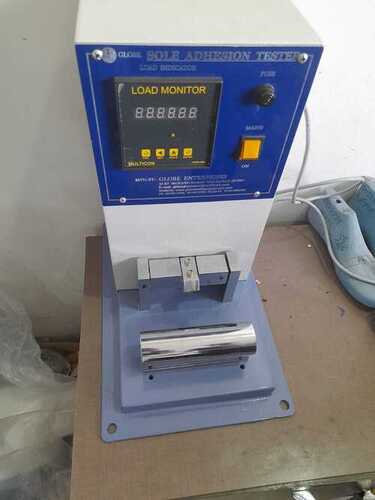
Sole Adhesion Tester
Price 65000.0 INR / Unit
Minimum Order Quantity : 1 Unit
Number of Specimens : 1 at a time
Display Type : Digital LED
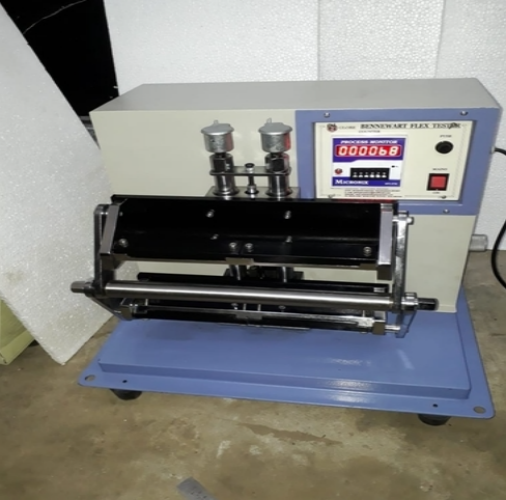
Bennewart Flex Tester
Price 80000.0 INR / Piece
Minimum Order Quantity : 1 Piece
Number of Specimens : 2
Material : MS
Display Type : Digital
Toe Cap Impact Tester
Price 85000.0 INR / Piece
Minimum Order Quantity : 1 Piece
Material : Metal
Type : Automation

We are mainly looking inquiries from Ghaziabad, Bahadurgarh, Kanpur, Agra and Chennai.
 Send Inquiry
Our Products
- Fabric Testing Equipments
- Foam Testing Equipments
- Footwear Testing Equipments
- Leather Testing Equipments
- Plastic Testing Equipments
- Rubber Testing Equipments
- Helmet Testing Equipement
- Yarn Testing Equipement
- Paper & Paperboard Testing Equipments
- Bursting Strength Tester
- Quadrant Scale
- Industrial Flammability Tester

373/7, Mukund Nagar, Industrial Area, Ghaziabad - 201001, Uttar Pradesh, India

Mr. Ishamuddin
(Proprietor)
Mobile :08045478105
 Send Inquiry
 Send SMS
Developed and Managed by Infocom Network Private Limited.
