
Call us now :08045478105
 Send Inquiry
 Send Inquiry
Specific Gravity Balance
Price 22500.0 INR/ Unit
MOQ : 1 Unit
Specific Gravity Balance Specification
- Accuracy
- 0.001 g
- Test Range
- 0.005 g to 200 g
- Specimen Size
- Solid or Powdered Samples up to 100 mm
- Response Time
- <3 seconds (Digital Version)
- Equipment Type
- Specific Gravity Balance
- Mounting Type
- Table Top
- Automation Grade
- Manual
- Measuring Range
- 0.005 g to 200 g
- Temperature
- 10C to 40C
- Resolution
- 0.001 g
- Number of Specimens
- Single Specimen at a Time
- Max Height
- Approx. 300 mm
- Usage
- For Laboratory Testing of Material Density
- Capacity
- 200 g
- Machine Weight
- Approx. 7.5 kg
- Test Speed
- Manual
- Control Mode
- Mechanical
- Case
- Protective Carry Case Included
- Level Indicator
- Integrated Bubble Level for Precise Balancing
- Sample Types
- Suitable for Metals, Plastics, Rubbers, and Minerals
- Pan Material
- Stainless Steel
- Calibration
- Supplied with Calibration Weights
- Balancing Beam Material
- Corrosion Resistant Brass/S.S.
Specific Gravity Balance Trade Information
- Minimum Order Quantity
- 1 Unit
- Payment Terms
- Cash in Advance (CID), Cheque, Cash Advance (CA)
- Supply Ability
- 100 Units Per Month
- Delivery Time
- 1 Week
- Main Export Market(s)
- Asia
- Main Domestic Market
- All India
- Certifications
- ISO Certified
About Specific Gravity Balance
The GLOBE Specific Gravity Balance provides a simple and quick mean to read directly the specific gravity of rubber and other elastomers, thus reducing labour and eliminating calculations. The time taken to find out the specific gravity of a sample is only about half a minute.The balance consists of an anodised scale with specific gravity (SG) printed on it standing vertically on a heavy base plate. A balancing arm is provided at the centre point of the scale. The arm is supported on two jewel bearings to minimise friction.
Two stainless steel pins are suspended from one end of the arm. One of the pins is attached through a short length of yarn and the other through a long length of yarn. The second pin is kept immersed in water inside a tall transparent jar kept on the base.
A pointer is attached at the other end of the balancing arm that indicates the specific gravity of sample under test. A sliding weight is also provided for initial balancing of the samples of different weights. A levelling screw is provided for initial levelling of the base plate.
A sample of any shape can be used for determination of specific gravity. Its weight shall, however, lie between 5 and 15 g. The sample used shall not be soluble in water or be affected by it in any way. If the sample has a cellular structure, the cells shall be of closed type so that the absorption of water is kept at minimum.
Other models of specific gravity balance capable of measuring specific gravity in the range of 0.2 to 2.0, 0.05 to 0.70, and 0.02 to 0.50 are also available. Special models for measurement of specific gravity of liquids and of materials in form of powder or granules are also being manufactured.
Technical specification
Frequency | 50 Hz |
Brand | Globe Enterprises |
Material | MS |
Voltage | 220 V |
Automation Grade | Semi-Automatic |
Precision Engineering for Reliable Results
Engineered with high-quality corrosion-resistant brass or stainless steel, the balancing beam delivers lasting performance even under challenging laboratory conditions. An integrated bubble level ensures mechanical accuracy, while the stainless steel pan offers robust support for various sample types, guaranteeing dependable readings every time.
Versatility Across Multiple Material Types
The Specific Gravity Balance accommodates metals, plastics, rubbers, and minerals, making it suitable for a wide range of laboratory density measurements. Its generous sample accommodationup to 100 mm, solid or powderedallows for flexibility in research and quality control environments.
Convenient Calibration and Portability
Each unit arrives complete with calibration weights and a protective carry case for safe storage and ease of transport between laboratories. The table-top design and manual operation make setup straightforward, while the built-in bubble level streamlines leveling and balancing procedures for precise results.
FAQs of Specific Gravity Balance:
Q: How do I calibrate the Specific Gravity Balance before use?
A: The balance is supplied with calibration weights. Begin by placing the instrument on a stable, level surface and using the integrated bubble level to ensure proper alignment. Follow the included instructions to use the calibration weights, verifying the balance provides accurate readings before proceeding with sample measurements.Q: What materials can be tested with this Specific Gravity Balance?
A: The balance is suitable for testing metals, plastics, rubbers, and minerals. It accommodates both solid and powdered samples with sizes up to 100 mm, making it versatile for a variety of laboratory applications.Q: When should I use this balance instead of digital alternatives?
A: This manual, mechanical balance is ideal when precise, hands-on measurements are required, or when digital equipment may not be available or desired. It offers reliable precision (0.001 g accuracy) and a fast response time in its digital version, making it suitable for laboratories prioritizing manual control and durability.Q: Where is the optimal placement for the balance during testing?
A: The balance should be placed on a stable, vibration-free table top in a controlled laboratory environment, ideally between 10C and 40C. Utilize the integrated bubble level to ensure the instrument is perfectly horizontal for the most accurate results.Q: What is the procedure for measuring the specific gravity of a specimen?
A: Position your single specimen (up to 200 g and 100 mm in size) on the stainless steel pan. Balance the beam using the mechanical controls, and record the reading. If digital, the response time will be under three seconds. Always recalibrate as needed to ensure ongoing accuracy.Q: What are the main benefits of using this Specific Gravity Balance?
A: The balance delivers laboratory-grade accuracy, robust construction, and flexibility in testing various material types. Its manual operation allows for precise control during measurements, while included features like a bubble level, calibration weights, and carry case provide enhanced convenience and reliability for regular laboratory testing.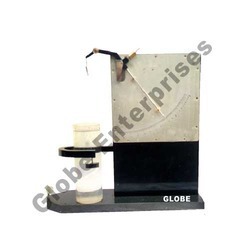
Tell us about your requirement

Price:
Quantity
Select Unit
- 50
- 100
- 200
- 250
- 500
- 1000+
Additional detail
Mobile number
Email

More Products in Rubber Testing Equipments Category
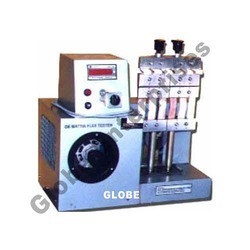
Demattia Flex Tester
Price 85000.0 INR / Unit
Minimum Order Quantity : 1 Unit
Application : Assessment of crack/flex resistance of rubber/vulcanized samples
Usage : Rubber testing laboratory equipment
Specimen Size : 70 mm (L) x 45 mm (W) approx.
Accuracy : 1 cycle
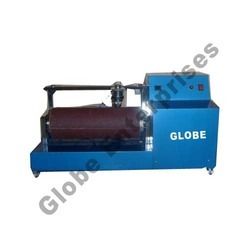
Din Abrasion Tester
Price 60000 INR / Unit
Minimum Order Quantity : 1 Unit
Application : Abrasion resistance testing for rubber, footwear, tires, conveyor belt materials, etc.
Usage : Quality Control, Laboratory Testing
Specimen Size : 6 mm thickness, 16 mm width
Accuracy : 0.1 mm
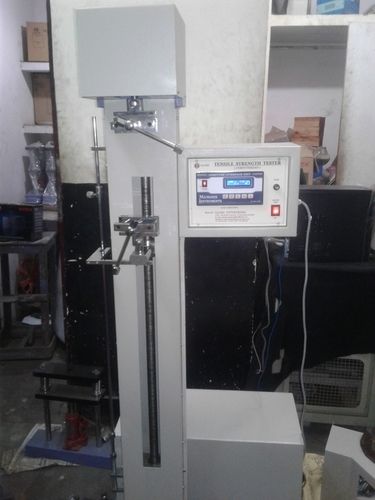
Tensile Strength Tester
Price 125000 INR / Unit
Minimum Order Quantity : 1 Unit
Application : Paper, Plastic, Rubber, Textile, Film testing
Usage : Material strength testing
Specimen Size : As per standards (ASTM/DIN/IS/ISO)
Accuracy : 1%
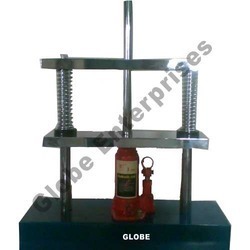
Specimen Cutting Press
Price 17500.0 INR / Unit
Minimum Order Quantity : 1 Unit
Application : Preparation of test specimens for physical testing
Usage : Laboratory specimen cutting
Specimen Size : As per standard die dimensions
Accuracy : Depending on die precision

We are mainly looking inquiries from Ghaziabad, Bahadurgarh, Kanpur, Agra and Chennai.
 Send Inquiry
Our Products
- Fabric Testing Equipments
- Foam Testing Equipments
- Footwear Testing Equipments
- Leather Testing Equipments
- Plastic Testing Equipments
- Rubber Testing Equipments
- Helmet Testing Equipement
- Yarn Testing Equipement
- Paper & Paperboard Testing Equipments
- Bursting Strength Tester
- Quadrant Scale
- Industrial Flammability Tester

373/7, Mukund Nagar, Industrial Area, Ghaziabad - 201001, Uttar Pradesh, India

Mr. Ishamuddin
(Proprietor)
Mobile :08045478105
 Send Inquiry
 Send SMS
Developed and Managed by Infocom Network Private Limited.
